Independent Suspension
Trailing arm and Semi-trailing arm suspension
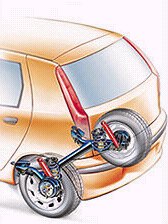
No matter semi-trailing arm or pure trailing arm suspensions, since they are rigidly attached to the wheels, inevitably more shock and noise could be transferred to the car body, especially under hard cornering or running on bumpy roads. Moreover, a lot of unsprung weight of the trailing arm leads to poorer ride quality. Therefore most modern sedans replace it with multi-link or double wishbones suspension. Trailing arm / Semi-trailing is disappearing in the industry.
| Advantage: | All round, few weakness. |
| Disadvantage: | Less refined than multi-link. |
| Who use it ? | Many sedans and coupes. |
 |  |
| Advantage: | Compact, cheap. |
| Disadvantage: | Theoretically inferior ride and handling. |
| Who use it ? | Most European mini cars up to Golf-class. |
Since the late 80s, multi-link rear suspension is increasingly used in modern sedans and coupes. The earliest applicants include Nissan 200SX, Infiniti Q45, Mercedes S-class and BMW 3-Series etc.
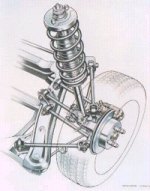 << Honda Accord's 5-link rear suspension
| Advantage: | Good handling and ride. |
| Disadvantage: | Not as cheap and as compact as MacPherson and Torsion beam. |
| Who use it ? | Mid-size to luxurious sedans. |
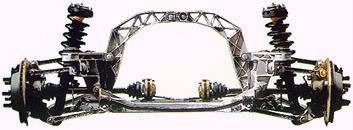
In the mid-70s, Porsche developed this unique rear suspension for its award-winning 928. Basically it is a variant of semi-trailing arm suspension.
| Who use it ? | Porsche 928. |
Sub-frame mounting
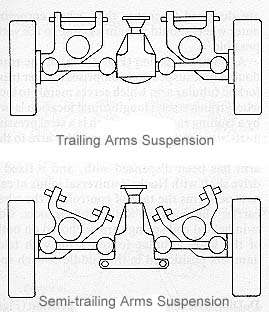
Trailing arm suspension (the upper picture) employs two trailing arms which are pivoted to the car body at the arm's front edge. The arm is relatively large compare with other suspensions' control arms because it is in single piece and the upper surface supports the coil spring. It is rigidly fixed to the wheel at the other end.
Note that it only allows the wheel to move up and down to deal with bump. Any lateral movement and camber change (with respect to the car body) is not allowed. Nevertheless, when the car rolls into a corner, the trailing arm rolls for the same degree as the car body, thus changes camber angle (with respect to the road surface). Now, you can see both wheels lean towards the outside of the corner, thus lead to understeer. Because of this reason, pure trailing arm was forgotten by car makers long long ago. Instead of it, they adopted semi-trailing arm.
Semi-trailing arm suspension (the lower picture) has the trailing arm pivoted at inclined angles - about 50 to 70 degrees. Otherwise are the same as trailing arm suspension. Apparently, the semi-trailing arms are half trailing and half transverse. You can analyse it by splitting it into two vectors, one is the trailing component and another is the transverse component. The trailing component leads to understeer, as already mentioned. On the other hand, the transverse component is actually equals to a swing axle suspension. Now, you may remember that the swing axle suspension always introduce oversteer due to body roll. As a result, the two components cancel each other and result in near neutral steering response.
Semi-trailing has a disadvantage - when the wheel moves up and down, camber angle changes, unlike double wishbones suspension.
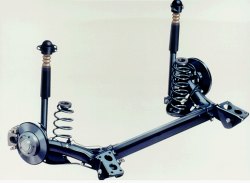
In fact, torsion beam suspension is only half-independent - there is a torsion beam connecting both wheels together, which allows limited degree of freedom when forced. For some less demanding compact cars, this save the anti-roll bars. On the contrary, it doesn't provide the same level of ride and handling as double wishbones or multi-link suspensions, although in reality it is superior to its only direct competitor, MacPherson strut. Most of the Europe's best handling GTIs employed this suspenion.
It is difficult to describe its construction because it is not strictly defined. In theory, any independent suspensions having 3 control arms or more are multi-link. Different designs may have very different geometry and characteristic, for example, BMW's multilink looks like a letter "Z", thus gave its name "Z-axle". It is relatively space-engaging but offers very good handling; Honda Accord's multi-link is essentially a double wishbones suspension added with the fifth control arm. Audi A4's Quadralink front suspension has four links. It looks alike double wishbones but eliminates torque steer.
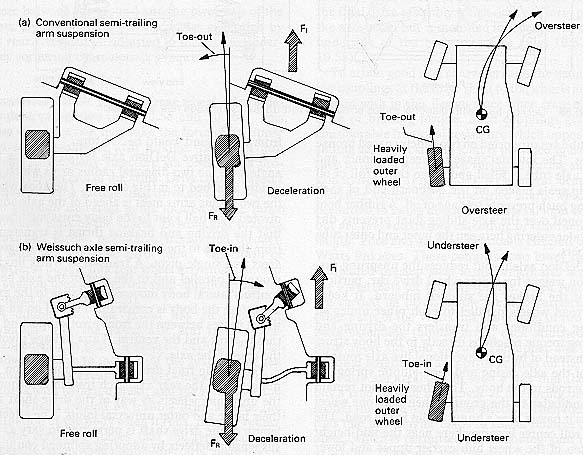
In any suspensions, the pivot joints must be inserted with rubber bushing to absorb noise and vibration. For conventional semi-trailing arm suspension (first row in the following picture), whenever under braking, the momentum of the car body tries to pull the car "away" from the rear suspension. Due to the elasticity of the rubber bushing, the rear wheel will toe-out. As a result, the car will oversteer.
Weissach axle was designed to eliminate this oversteer (second row in the picture). By splitting one trailing link into two pieces, with a pivot joint added between them, the oversteer under braking can be elinimated or even introduce some understeer ! This help stablizing the cornering motion. Some people call it as "passive rear-wheel steering".