
Adaptive Suspensions
Adaptive damping
Ferrari and Maserati are the keenest users of adaptive damping. The former's Mondial T, F355, 456GT, 550M, 360M and the latter's Shamal, Quattroporte and 3200GT all employed electronic adjustable dampers in the suspensions. In most of the time, the damper is in "soft" setting to benefit ride comfort. In case the car goes in action, it is set to "stiff" mode for stable handling and minimize body roll.The mechanism is usually very simple. By varying the total area of valves area within the shock absorber, different rate of damping can be obtained. Therefore the shock absorber alone is able to implement the adaptive damping.
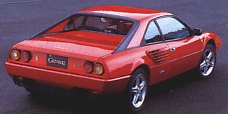 | Ferrari Mondial T - the earliest Ferrari to have adaptive damping. |
It looks great, but the effectiveness is quite limited. Firstly, it can just vary the damping rate, not the spring rate and anti-roll bar function. Secondly, individual wheel or axle cannot be set according to need. All four wheels always run on the same damping setting. Thirdly, it seems that until now all the designs still react slowly, therefore they are employed to deal with the changing driving style (which is more consistent) rather than the change of road condition (which is fast-changing and unpredictable).
Semi-Active Suspension
Citroen XM's Hydractive
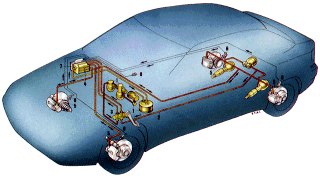 | XM's Hydractive system. Note that there are totally 3 spheres in the rear axle. All the suspensions are interconnected with high-pressure hydraulic which is supplied by the engine-driven pump. The front spheres are not shown in this picture. |
The Hydractive, which appeared in the XM as optional equipment since 1989, was based on the company's traditional "Hydropneumatic suspension". The latter has a large sphere at the top of each shock absorber. Within the sphere there are 2 compartments filling with compressed air and high-pressure fluid respectively, separated by an elastic barrier. The gas acts as conventional suspensions' spring while the fluid acts as damper. Shock from the wheel transmit via the fluid into the elastic barrier, than compress into the gas compartment. The gas absorbs the energy and release back to the fluid, which smooth the reaction by its damping effect. Remember, in the "Hydropneumatic suspension" there is no spring and damper. The sphere does the jobs of both.
Now comes to the sophisticated Hydractive suspension. It still employs the spheres at each corner, but added with an extra sphere (central sphere) at each of the axles, linking by fluid between the spheres at left and right wheel. The front and rear central spheres also link each other. In other words, the front and rear, left and right suspensions are all interconnected by high-pressure fluid.
With the addition of central spheres, the total volume of gas and fluid increases. Therefore the suspension can provide softer spring and damping rate that requires by comfortable ride. Moreover, like the conventional Hydropneumatic suspension, the fluid can flow from one wheel to another, one axle to another, thus further smoothen the ride.
When the car need stable handling and roll resistance, valves in the central spheres close, thus isolating the wheel's spheres. As the volume of gas and fluid has been reduced, stiffer spring and damping rate are obtained.
The setting is not just bounded to "soft" and "hard" only, since there are many valves associated in the central spheres. The more valves close, the stiffer the suspension becomes. In fact, Citroen added more valves to the Hydractive 2 system in 1993 in order to create more level of setting and smoother transition between soft and hard.
What made the Hydractive so effective is its fast-reacting brainpower. Powerful computer analysis the data acquired by speed, g-force, throttle, brakes and gearbox sensors, then decide the most suitable setting and activate the valves via solenoid and sophisticate power electronics.
Because the energisation of the solenoid valves takes as long as half a second while de-energisation need merely 2 milliseconds, Citroen use the de-energisation to actuate the closure of valves, thus making the change from soft to hard setting far quicker than vice versa. This is very logical, as we always need stiff suspensions as soon as we start driving hard. We don't need to enjoy comfortable ride as soon as we ease off the throttle.
Citroen C5's Hydractive 3
The third generation of Hydractive suspension is relatively simple to explain. The system, introduced in C5 in early 2001, was a refinement of the previous generation. Unlike Activa (Hydractive 2), it does not have the active anti-roll bar which was criticized by some as feeling unnatural. Instead, it added variable ride height function, which is easily to implement in hydraulic suspension. By adding or removing fluid in the suspension, ride height can be varied. At speed, ride height will be decreased to reduce aerodynamic drag and improve stability. By lowering the front end a few mm more than the rear also introduce some more downforce (well, may be less lift). At low speed, ride height will be increased to provide more bump travel and avoid contacting with ground obstacle. Off road at really low speed the ride height will be adjusted to maximum.The best of the Hydractive 3, however, is the recalibration of the software system to provide firmer yet smoother cornering without the nervous reaction of the previous generations. Moreover, by reshaping the gas-fluid spheres, the system becomes more durable, without needing maintenance until 200,000 km or 5 years.
As before, electronics sensors monitor steering action, brake pedal pressure, engine speed etc. to know the driver's driving style. If it sense a leisure driving style, electromagnetic valves will be opened thus link the center sphere of each axle with left and right suspension spheres, hence increasing volume of gas and fluid thus provides softer spring and damping rate. In contrast, for sporty driving style the center sphere will be isolated from suspension spheres thus increase spring and damping rate, providing a firmer ride and better body control.
Active Roll Control
Citroen Xantia's Activa
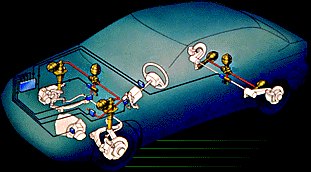 | Xantia Activa has even more spheres. Note the additional sphere incorporated in the front anti-roll bar. |
Hydractive reduce body roll by stiffening the spring and damper in the price of ride. If it could stiffen the suspensions to as hard as Formula One racing cars, it would have achieve near-zero body roll under hard cornering. However, because we need an acceptable level of ride comfort in a road car, we cannot do that. Therefore Citroen developed the active anti-roll bar, added it to the Hydractive and becomes Xantia's Activa system.
Based on the Hydractive, Activa incorporates a gas-filled sphere in the middle of the anti-roll bar. The anti-roll bar is unusually thick at a diameter of 28 mm up front and 25 mm at the rear. The sphere acts as a cushion, thus allows the anti-roll bar to be twisted more easily. Therefore, the 28 mm anti-roll bar actually performs like a 23 mm one, thus offer less anti-roll function for normal drive.
When the car goes into a corner quickly, computer detects body roll thus close the valves in the sphere. This isolate the gas in the sphere thus eliminate the cushion effect. The anti-roll bar thus resume its original stiffness, acting exactly as a 28 mm anti-roll bar.
It doesn't end here. If the lateral acceleration is so strong that body roll continues to exceed 0.5 degree, fluid will be fed into 2 hydraulic rams at the front and rear which adjust the anti-roll bars to keep cornering level.
At any time, Xantia Activa rolls at most half a degree. This make it not only spectacular to look at, but also improve cornering speed. French magazine L'Automobile tested a Xantia Activa on skidpad and measured an amazing 0.94 g lateral acceleration. This compares competitively with many supercars - NSX managed 0.93 g, Ferrari 512TR 0.92 g, Toyota Supra 0.95 g and Ferrari F40's 1.01 g. This is even more impressive if you consider the Xantia wears just 205/55R15 tyres ! Most cars in its class manage around 0.8 g only ! 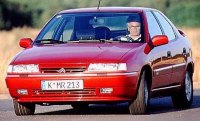 << Xantia Activa cornering without roll
Mercedes' Active Body Control (ABC)
Compare with Citroen’s Activa, Mercedes’ ABC (Active Body Control) seems rather simple. ABC is a purely active roll control device. It can vary spring rate but not damping, unlike Citroen’s Hydractive or Activa. Therefore it is not classified as semi-active suspension. However, the application in the new CL coupe demonstrate it helps achieving a stable and fluent cornering. It also saves the need of anti-roll bar. 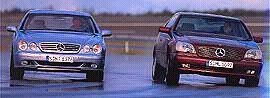 The mechanical is quite simple. Each of the four wheels rides on a thick strut which incorporate both spring and damper into a single unit. The damper is in the core of the strut, surrounding by the coil spring which is topped by a fluid chamber. When the chamber is fully filled with fluid (supplied from hydraulic pump), the spring is pushed towards the wheel and compressed, thus resist body roll. On the contrary, if the fluid chamber is emptied, the spring will be released towards the top of the strut, thus become softer. ABC is not very fast-reacting - the maximum frequency of change is just 5 Hz, because the filling of fluid takes time - but that’s more than enough for dealing with body roll. | 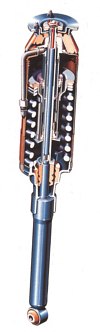 |
Lotus' fully active suspension
Unquestionably, active suspension is the most ideal suspension. A true active suspension has double-acting hydraulic actuator instead of springs and dampers. As tyres meets bump, the wheel's acceleration and vertical load is transmitted to a computer which calculates the required wheel velocity and displacement and sends control signal to the actuator. As the dialogue is conducted hundreds of times a second, the wheel accurately follows the contour of a bump, thus protecting the body structure against unwanted forces.When riding on a bump, Active suspension, Hydractive suspension and Adaptive damping react very differently. The following explain how they "think":
Adaptive damping : "A shock encountered ! Another shock ! Again another .... Oh, it seems that the car is running slowly on bumpy road, let me change the damping rate to soft setting."
Hydractive suspension : "A shock encountered ! I must be riding on a bump. As the car is running slowly, I must change the suspension to soft-intermediate setting .... OK, I've changed .... Oh, the body still accelerating upward ! This means the suspension is still too hard. I should have changed to soft setting ! It's too late. The bump has already been passed."
Active suspension : "A shock is encountered ! I start riding on a bump. Vertical acceleration sensor and speed sensor tells me the bump is quite high. OK, signal the wheel actuator to compress 10 mm progressively .... sensors tell me it's not enough. Well, this time compress another 8 mm and see what's going on .... 6 mm this time .... 4 more mm .... 3 .... 2 .... 1 .... Wow ! I am riding on the peak right now ! Start releasing the actuator for 1 mm .... 2 mm .... 4 mm .... 7 mm .... 10 mm .... Return to flat ground ! Well done !"
As you can see, active suspension is simply a perfect concept. Theoretically it could absorb all the shock while maintaining the car body stable. Engineers dreamed for it long ago, but it was Lotus that put it into reality.
Lotus started researching active suspension in 1981, originally intended to equip its Formula One racing cars. The active F1 ran in Brazil and Long Beach '83 in the hands of Nigel Mansell. Despite of lacking competitiveness, it proved that active suspension could withstand hard use at 180 mph and 3 g lateral acceleration. The development team went back to drawing board and did more test to improve the software. It was not raced again until 1987, when the Honda-powered 99T won 3 races in the hands of Ayrton Senna.
However, the active suspension did not offer sufficient advantage in F1 racing. Theoretically, it could raise cornering speed considerably. ("Cornering at 200mph" used to Team Lotus's slogan when defending this technology.) But on the down side, its hydraulic pump consumed horsepowers. I don't have the exact figure, but years later Lotus told us the active suspension in its Excel development car consumed 4 - 4.5 hp on smooth road and up to 9 hp on rough road. Worst of all, Team Lotus did not get specially developed tyres to extract its potential. As the active suspension reduced tyre's slip angle, the tyres generated insufficient heat to attain the necessary working temperature.
Just after the F1 debut in the 1983 season, Lotus Engineering started developing the active suspension technology for production car use. It used the Esprit as the development platform. Like the racing car, the hardware - hydraulic actuators - came from aerospace industry, where active suspension was used in advanced jet engines. According to the engineers involved, the most crucial part was the software rather than hardware. They had to road test a lot to acquire the necessary data in order to write the program.
The first 2 generations were springless, but the Mk III and Mk IV system, which were equipped in the Excel development cars, had springs as back up in case the active system break. The software was gradually improved. British magazine Fastlane tested them twice, once in the '87 Mk III and then in the Mk IV two years later. In the latter it reported significant improvement in ride quality and body control. It also expressed full optimistic that the system would go into mass production within a few years, probably under the name Volvo, Chevrolet or Mercedes-Benz, as they all had been consulting Lotus.
This did not come true. Until today I haven't seen any sign that car makers are going to put a fully active suspension into production. The main reasons, I guess, are likely to be cost, power consumption and reliability. The only successful application was still in motor racing - between 1992 and 1994, F1 championship were dominated by the active Williams and Benetton. Meanwhile, DTM series also saw active suspension's superiority in Mercedes C-class and Opel Calibra. Perhaps it was too superior, FIA eventually banned it.
The last time I heard Active suspension was in 1995 (?), when Lotus showed the Esprit SDIII development car. After that, the automotive world seems to have forgotten the most ideal suspension ever appeared.
Some people was misled by Nissan Infiniti Q45a of 1990. Nissan called the car's suspension as "Fully Active" but that was actually a lie. It was just an adaptive damping, with conventional coil springs taking care of compression and an hydraulic device dealing with rebound.
The Kinetic suspension was invented by Australian engineer Chris Heyring. American component maker Tenneco acquired its patent in the late 1990s and developed it for production. Early adoptors include Citroen C4 rally car (before WRC banned the tech) and Lexus GX470 SUV. This suspension utilizes hydraulic and gas pressure to provide active anti-roll function, saving the need for conventional anti-roll bars thus improving ride comfort. It may also provide adaptive damping, therefore it is regarded as semi-active suspension.
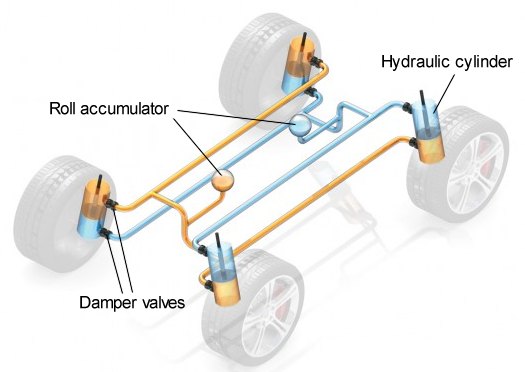
The hardware of Kinetic suspension looks similar to Citroen's Hydractive suspensions, but it differs in details and principles. In place of conventional dampers are four hydraulic cylinders, each contains a compression chamber and an expansion chamber. They are interconnected in a way that the compression chambers on the right wheels link to the expansion chambers on the left wheels, vice versa. Besides, front and rear wheels are connected. The picture below should give you a clear idea:
Now see my exclusive illustration below. In case the car steers quickly to one side, centrifugal force is built up at the opposite side, leading to body roll. As a result, the inside wheel dips and the outside wheel compresses. This leads to the orange circuit attains increased pressure from both cylinders, driving more oil into accumulator A. On the contrary, the blue circuit attains reduced pressure from both sides, therefore oil flows from accumulator B to both cylinders.
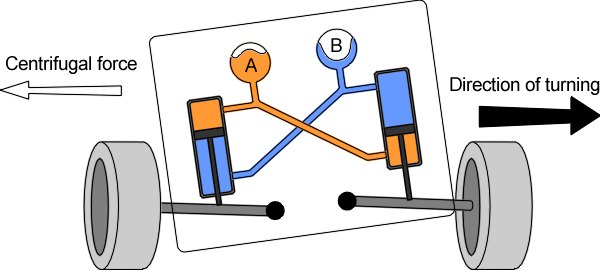
What if the car is not cornering, but hitting a bump on the road ? Oil from the compressed wheel will flow towards other wheels, thus the suspension absorbs the bump comfortably. In contrast, conventional suspensions with anti-roll bars always return a stiff ride on road irregularities.
How does the Kinetic suspension achieve adaptive damping ? Turn back to our first picture, you can see the oil flows in/out the hydraulic chambers via a valve, whose degree of opening is adjustable. This ensure the ECU can control the speed of oil flow, hence the damping rate.